
What National Anthems Quietly Stopped Singing
NB: Methodology, raw scores and code are all open here: github.com/rorads/open-web-analysis. This is the first piece built with the repeatable method I describe separately.
France’s Marseillaise contains the line “qu’un sang impur abreuve nos sillons” – “let impure blood water our furrows.” The United States’ anthem has a verse gloating over the “gloom of the grave” awaiting a hired enemy. You have almost certainly never heard either line, because almost nobody sings past the first verse. France, mercifully, mostly sings the first.
That gap – between what an anthem says and what a nation actually performs – turns out to be measurable. So I measured it, for all 195 of them.
How (in one paragraph)
Each anthem was scored on fourteen themes, on a 0–3 scale, twice: once for the complete official lyrics (“as written”) and once for the verses customarily performed (“as sung”). Most themes just describe the song; a handful roll up into composite indices. Every score is pinned to a quoted line from the actual text rather than the model’s memory of it, and a second, independent pass re-scored a sample blind to check the first. The full method, and why it’s built the way it is, is its own post; the taxonomy looks like this:
flowchart LR
T[Anthem text<br/>as-written & as-sung] --> RB{14 themes<br/>scored 0–3}
RB --> B[war · blood · enemy · sacrifice]
RB --> D[deity]
RB --> M[monarch]
RB --> O[land · freedom · unity · glory<br/>labour · flag · ancestors · wildcard]
B --> BI[[Belligerence index]]
D --> DI[[Deity index]]
M --> CI[[Crown index]]
O --> FP[[Thematic fingerprint]]
style T fill:#2d8cff,stroke:#fff,stroke-width:2px,color:#fff
style RB fill:#1e293b,stroke:#fff,stroke-width:1px,color:#fff
style BI fill:#f43f5e,stroke:#fff,stroke-width:2px,color:#fff
style DI fill:#fbbf24,stroke:#fff,stroke-width:2px,color:#fff
style CI fill:#f59e42,stroke:#fff,stroke-width:2px,color:#fff
style FP fill:#10b981,stroke:#fff,stroke-width:2px,color:#fff
The verses nations quietly retired
Performing an anthem is largely an act of editing. Aggregate belligerence falls from a written mean of 24 to a sung mean of 19; the count of completely peaceable anthems rises from 57 to 72 once you only score what’s sung. The move only ever goes one way – no country sings a more warlike version than it published.
Some countries have a very large gap indeed:
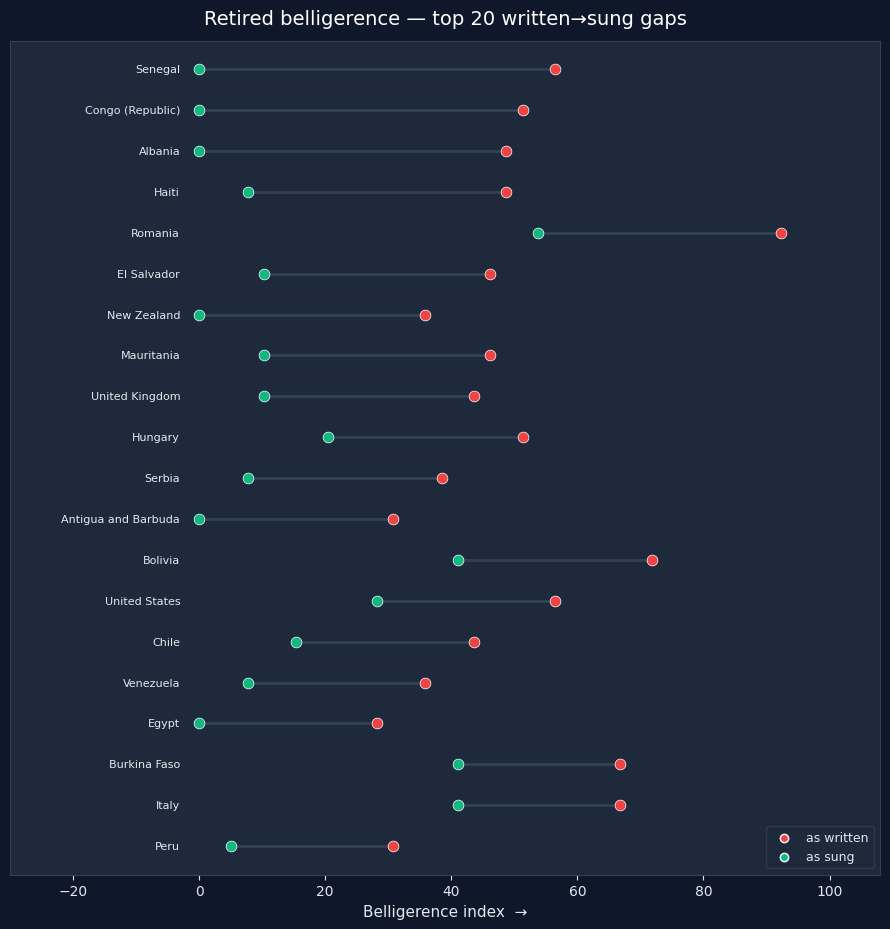
Senegal tops the list: a full-throated “if the enemy violates our frontiers, we will all be ready, weapons in our hands” sits in a verse nobody performs. Then come Congo-Brazzaville, Albania and Romania. The familiar names are there too – the UK keeps “scatter our enemies, make them fall” in the official text and never sings it; the US shelved its third verse about a “hireling and slave” long ago. Whole nations have mellowed without amending a word on paper, simply by declining to reach the second verse.
This is the bit I find most telling. An anthem’s full text is a historical artefact, fixed at the moment of writing; the sung version is what a country is comfortable saying about itself out loud today. The distance between the two is a quiet, unlegislated edit – a nation editing itself by omission.
God and guns repel; God and crowns attract
A side-finding, but a good one. You might expect the anthems most fixated on divine favour to also be the most warlike – God and country, smite our enemies, and so on. The data points the other way. Across the 192 anthems with lyrics, invoking God is mildly negatively correlated with belligerence (Pearson r = −0.26). The bloodiest anthems – Algeria, France, Vietnam, Tunisia, Cuba – are resolutely secular, products of revolutions rather than churches.
Where God does appear, a monarch is usually close by: deity and crown correlate positively (r = +0.26). Devotion travels with the throne.
The chart below is one point per country – belligerence along the bottom, God up the side. Hover for the country (the bottom-right corner is crowded, because a great many secular anthems are extremely cross):
The one country gamely holding up both ends of the axis is Sudan, whose anthem opens, with no ambiguity whatsoever, “We are the army of God.”
What anthems actually sing about
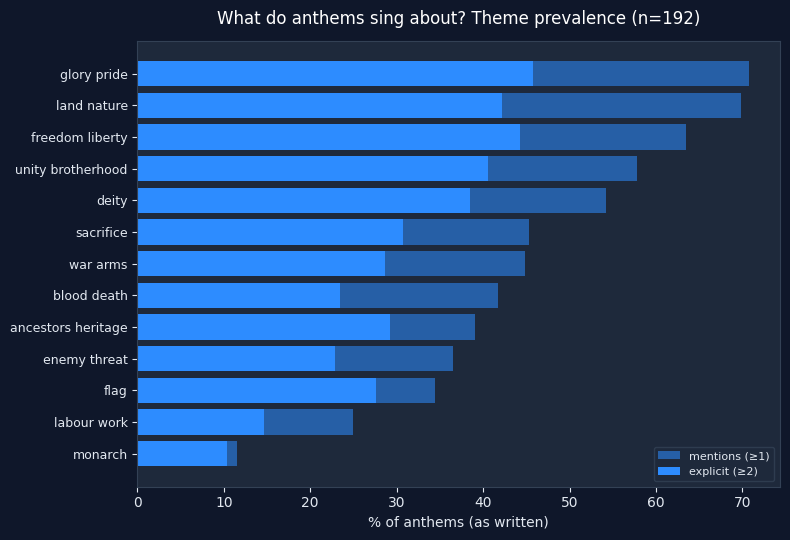
Set the warlikeness aside and just count themes. The most common thing an anthem does is boast (glory and pride, 71%) or describe the scenery (land and nature, 70%). The monarch – the very thing we picture when we picture an anthem – is the rarest theme of the lot, in barely one in eight, which rather undersells the brand.
Broken down by region, each gets a recognisable fingerprint:
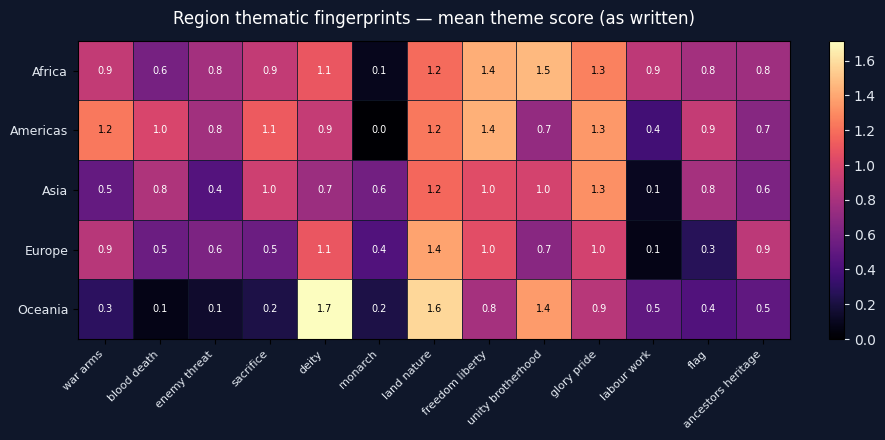
The Americas are the martial bloc – war, blood and sacrifice, with precisely zero monarchy (being uniformly republican). Africa sings about labour and unity, the “build the nation” register of post-independence. Europe leans on heritage and ancestors, its older anthems reaching furthest back. Oceania is the pious-pastoral outlier: lots of God and landscape, almost no belligerence at all. For a quiet life, the Pacific writes the calmest anthems on Earth.
Thematic families, and the world’s most average anthem
Cluster the countries on their full theme vectors and five families emerge: royal/devotional, pastoral/civic, a labour/developmental group, a revolutionary/martial group, and a flag/patriotic one (the United States’ natural habitat). The most thematically distinctive anthem is Romania’s – a maximalist tour through ancestors, heroes and battle. The most thoroughly average – closest to the global mean on every axis – belongs to Saint Kitts and Nevis. No notes; a perfectly representative national anthem.
While we’re here: the intuition that older anthems are more warlike doesn’t survive contact with the data (age against belligerence, r = −0.10). A nineteenth-century anthem is no bloodier, on average, than one written last decade.
The rubric’s junk drawer earned its keep
I gave the rubric an “anything else” slot for themes I hadn’t anticipated. It filled up fast, and three of its contents recurred often enough to be promoted to first-class themes in a second pass: labour, the flag, and ancestors. The escape hatch had been quietly holding three real themes I’d failed to plan for. (Next in the queue for promotion is peace – the explicitly anti-war anthems, of which there are more than you’d think.)
The genuinely unpromotable residue is the best part: the things exactly one country sings about. Lebanon has its cedar, Guatemala its quetzal, China its Great Wall, Mongolia its national emblem, and Moldova – wonderfully – sings about the Moldovan language itself. Paraguay’s contribution to the genre is the motto “Republic or Death,” which is at least decisive.
How much should you trust this?
A fair question, given a language model did the scoring. Two guards. First, every score is tethered to a quoted line, so the model can’t credit a country with bloodlust it can’t point to. Second, an independent pass re-scored a stratified sample of fifteen anthems without seeing the first set; the two agreed within one point on 96% of judgements.
Where they disagreed was the useful bit. It caught that I’d under-scored Senegal (the unsung martial verse, now corrected – and now the biggest gap of all), and that I’d over-read Mongolia, where “our sweat and blood” for the homeland is the idiom for hard work rather than a literal claim (or at least a more abstract sort of blood).
The honest caveats: translations can soften or sharpen a line (flagged per item); “as sung” is a genuine judgement call for a few countries; and a high God-or-crown score reflects the era a text was written in, not a country’s present-day religiosity or politics. The rubric, scores and quotes are all in the open, so you can argue with any individual call – which is rather the point.
This was the first analysis built with a repeatable rubric-scored method – assembled, as it happens, entirely from a phone.